Radharani
Kangra Miniature Painting: How the Himalayas Reimagined Braj
यह लेख अभी केवल अंग्रेज़ी में उपलब्ध है।
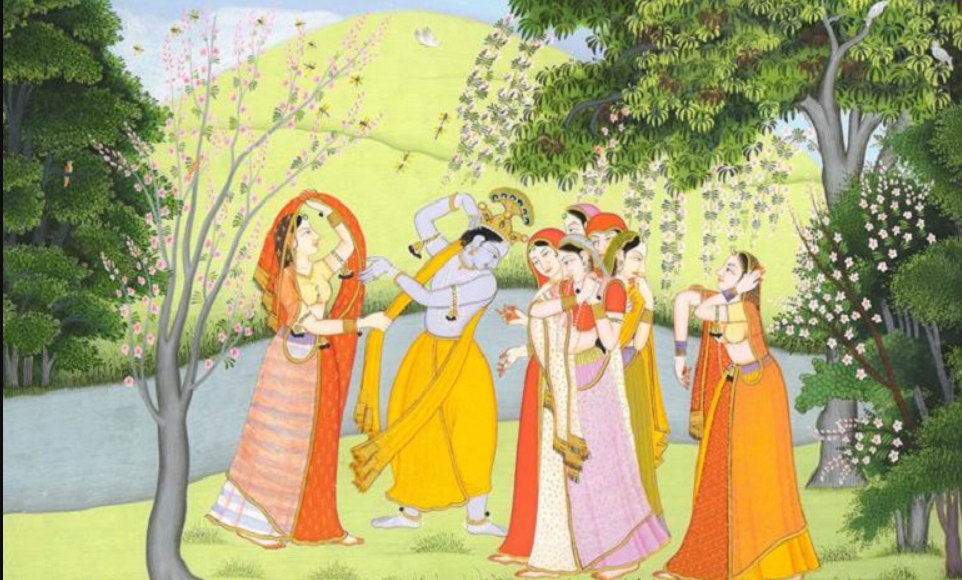
Braj was not only remembered in the hills. It was rebuilt there — stream by stream, grove by grove.
The Origin & Regional Context
When Delhi fractured in the 18th century following foreign invasions like that of Nadir Shah in 1739, master court painters left the arid plains in search of refuge. Climbing into the lower Himalayas, they found generous patrons across the hill kingdoms, most notably Maharaja Sansar Chand Katoch in Kangra.
Here, an extraordinary aesthetic transformation occurred: Braj was transplanted into the mountains.
Mathura’s parched earth and seasonal heat gave way to alpine streams fed by snowmelt. The thorny scrub forests of the plains were transformed into shaded hillside groves filled with weeping willows, wild clover, and intertwined creepers. Krishna was no longer walking under a blistering sun; he strolled across terraced valleys wrapped in saffron robes against mist-laden peaks. Hill painters did not simply illustrate an ancient scripture — they offered their native geography as an intimate sanctuary for the divine lovers.
Visual Grammar & Iconography
The Signature Profile (Ek-Chashm)
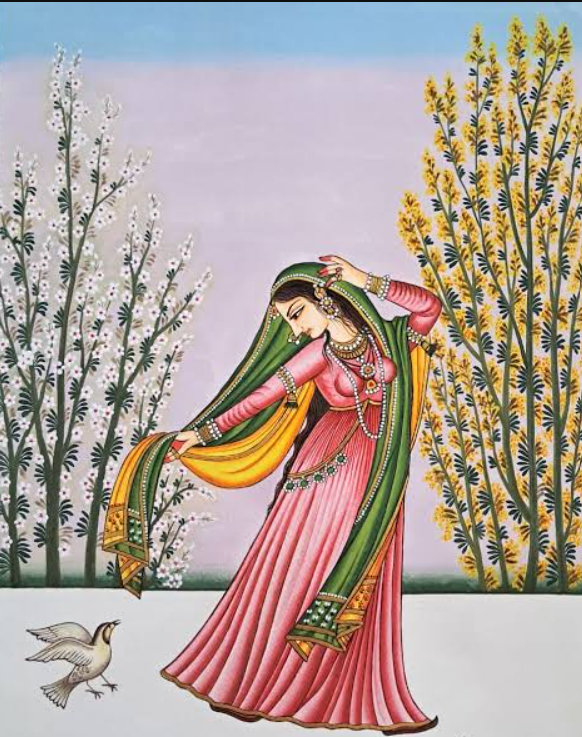
Figures are almost exclusively rendered in pure profile. The iconic Kangra face features a forehead that flows into a straight, sharp nose without a bridge dip, complemented by long, half-closed lotus eyes (padmapatrakshi) and a delicate, rounded chin.
The Emotional Framework (Rasa & Bhava)
The visual rhythm is governed by Sringara Rasa — the aesthetic sentiment of romantic and divine love — animated by Rati Bhava, the foundational emotion of deep, passionate love. Under the Bhakti movement, this is elevated into Madhur Bhava: approaching the divine not in awe or fear, but with the intense, tender intimacy of an equal lover.
The Dual States of Love (Samyoga & Viyoga)
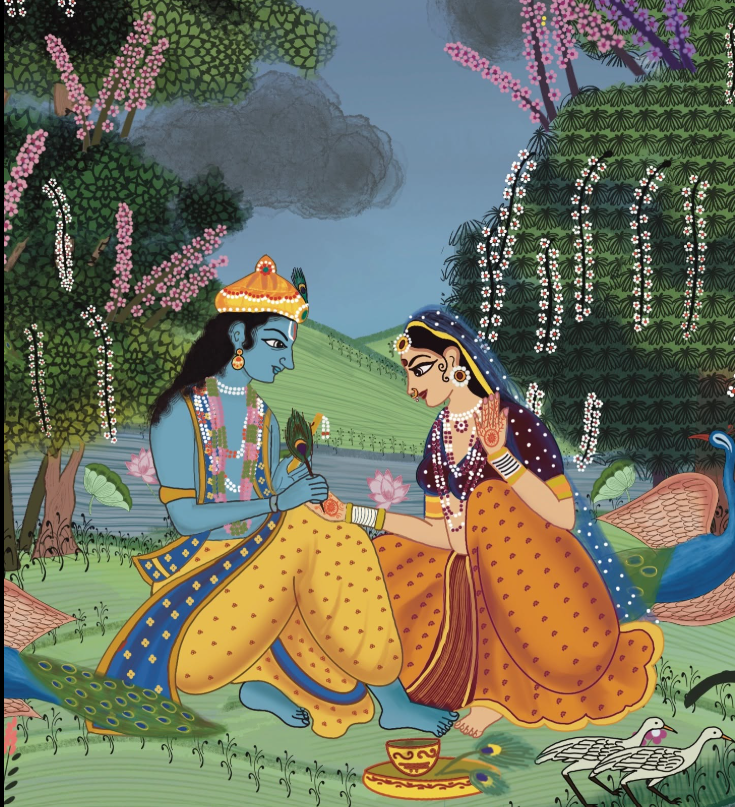
Samyoga Sringara (Love in Union) is visualized through balanced, harmonious compositions. Radha and Krishna share a single cloak (chadar), exchange quiet gazes under flowering arbors, or sit close amidst blooming bowers and tranquil surroundings.
Viyoga / Vipralambha Sringara (Love in Separation) is communicated through visual tension and solitary framing. Radha is portrayed seated alone on an open marble terrace or wandering turbulent forest paths, her distress echoed by anxious body language and watchful attendants.
Nature as Emotional Mirror (Uddipana)
Landscape is never passive scenery. Nature acts as an Uddipana Vibhava — an excitant of interior emotion. When Radha longs for Krishna during separation (Viraha), thunderclouds darken the sky, lightning snakes across the frame, and creepers twist around bare branches. When the lovers reunite, groves burst into coordinated blossom, and gentle deer gather in the clearing.
The Dynamic Waters
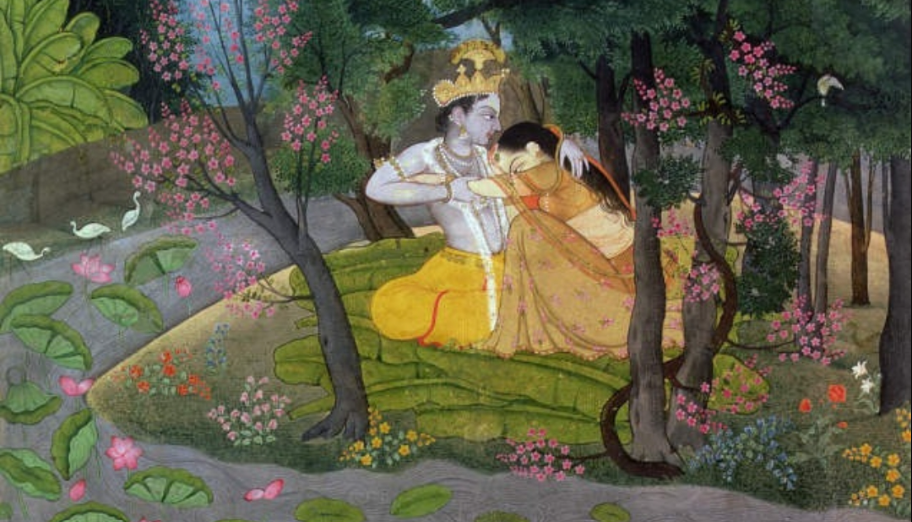
The Yamuna is portrayed as a living emotional witness. Choppy, dark ripples mirror tension and separation, while calm waters dotted with blooming pink lotuses signify peace and spiritual fulfillment.
Spatial Framing
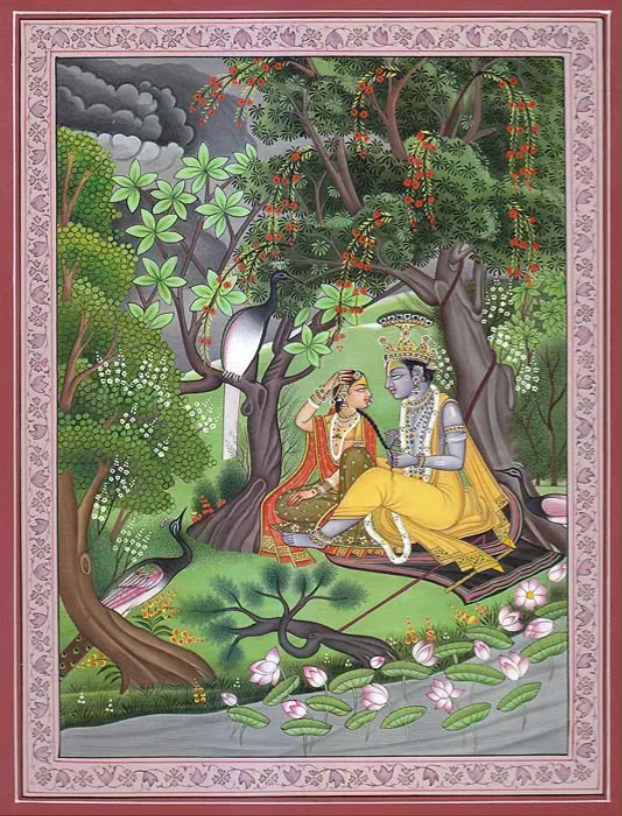
Radha and Krishna are rarely enclosed inside cold palace halls. They are framed by open pavilions (baradaris) or secluded natural arbors (kunjs), keeping the sacred narrative rooted in living nature.
Material Anatomy & Process
- The Canvas (Sialkoti Wasli): Layers of handmade cotton and bamboo paper were bonded together using starch paste to create wasli. The sheet was burnished with a smooth river agate (golla) until it took on the cool sheen of polished marble.
- Natural mineral & plant pigments:
- Blue: Ground lapis lazuli imported across mountain passes, complemented by vegetal indigo.
- Yellow (Peori): Sourced through traditional organic methods to create the luminous golden glow of Krishna’s Pitambara robes.
- Green: Pulverized malachite and terra verde (green earth) for dense Himalayan foliage.
- White & outlines: Incinerated conch shells for radiant whites, with fine lampblack used for delicate contour lines.
- The Squirrel-Hair Brush (Kalam): The finest linear work was executed using brushes fashioned from just one or two hairs taken from the belly of a mountain squirrel, set inside bird quills for hair-thin control.
The Literary & Spiritual Roots
- Jayadeva’s Gita Govinda: The 12th-century Sanskrit lyric served as the primary narrative foundation, inspiring full visual suites that map Radha and Krishna’s romance through every stage of devotion.
- The Classification of Emotion (Nayika Bheda): Painters used classical Sanskrit poetics to classify Radha into eight archetypal heroines (Ashta-Nayika). Whether portrayed as the Abhisarika (braving storms and serpents to seek her lover) or the Khandita (confronting an unfaithful partner), the folios translate divine devotion through relatable human emotion.
- The Mood of Intimacy: Devotion here is anchored in Madhurya Rasa — approaching the godhead through tenderness, vulnerability, and love, rather than awe or fear.
Heritage, Lineage & Field Notes
- The Lineage Discovery (Dr. B. N. Goswamy’s breakthrough): For decades, art historians classified Pahari paintings strictly by princely courts — the “Kangra court style”, the “Guler court style”. Dr. B. N. Goswamy overturned this framework by proving that style belonged not to stationary courts, but to wandering family workshops (gharanas). By examining pilgrimage priest registers (bahis) in Haridwar, he traced the master lineage back to the workshop of Pandit Seu and his sons, Manaku and Nainsukh, whose extended family carried this refined artistic practice across the hill kingdoms.
- Geographical Indication (GI) status: Kangra Miniature Painting holds legal protection under the Geographical Indications of Goods Act (GI Application No. 381, Certificate No. 214, dated 31 March 2014), certifying it as an authentic heritage craft of Himachal Pradesh.
- Archival repositories & collections:
- Government Museum and Art Gallery, Chandigarh — housing the landmark collection assembled by Dr. M. S. Randhawa.
- National Museum, New Delhi.
- Himachal State Museum, Shimla.