Radharani
The Kishangarh School: The Court That Painted Distance
यह लेख अभी केवल अंग्रेज़ी में उपलब्ध है।
The Origin & Regional Context
Kishangarh was a small Rathore state in central Rajasthan, near Ajmer, founded around 1609 by Kishan Singh of Jodhpur. Most such courts painted close: a ruler, a horse, a terrace, a wall of colour behind the head. Kishangarh had something most of them did not — Lake Gundalao, a wide sheet of water lying below the town, with the fortress-palace of Rupnagar above it. The school’s whole later grammar is an argument with that view.
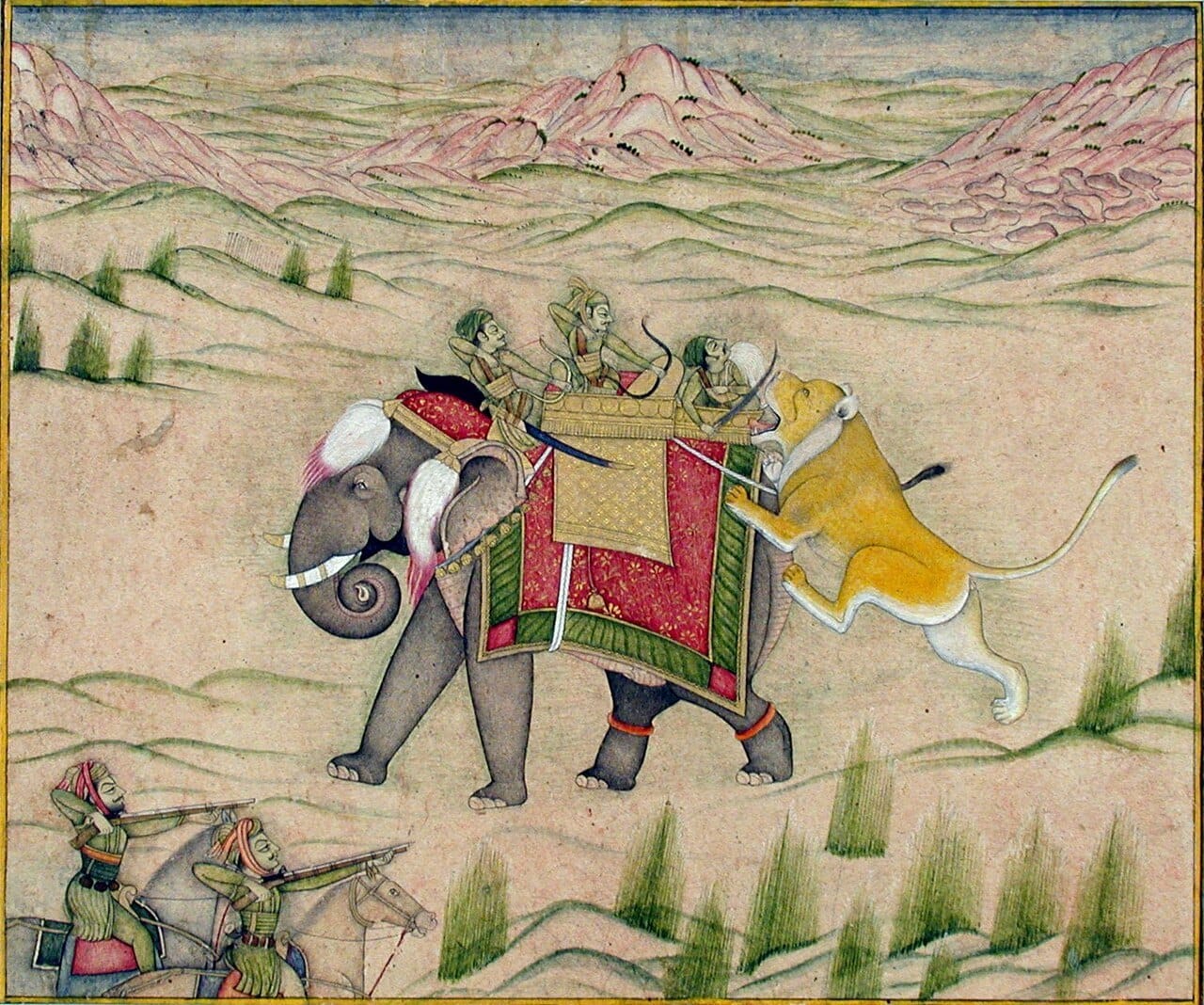
Technique arrived from outside. Around 1719 Bhavani Das, trained in the imperial workshop at Delhi, entered Kishangarh service, bringing fine controlled line, modelled faces and careful recession; his son Dalchand continued it. Recession is the point here. The imperial manner knew how to build depth, and in a state whose best view was a long one, that skill found a subject. Nihal Chand (1710–1782), chief painter from about 1735 to 1757, took the inherited technique and pushed both ends of it at once — the figures toward abstraction, the space toward real distance.
What the court wanted painted in that space was Braj. Kishangarh was a Vaishnava house, its ruler a Krishna poet, and its atelier spent the best years of the school on the lila — Radha and Krishna in a garden, on the water, in a pavilion, out in the dark.
Visual Grammar & Iconography
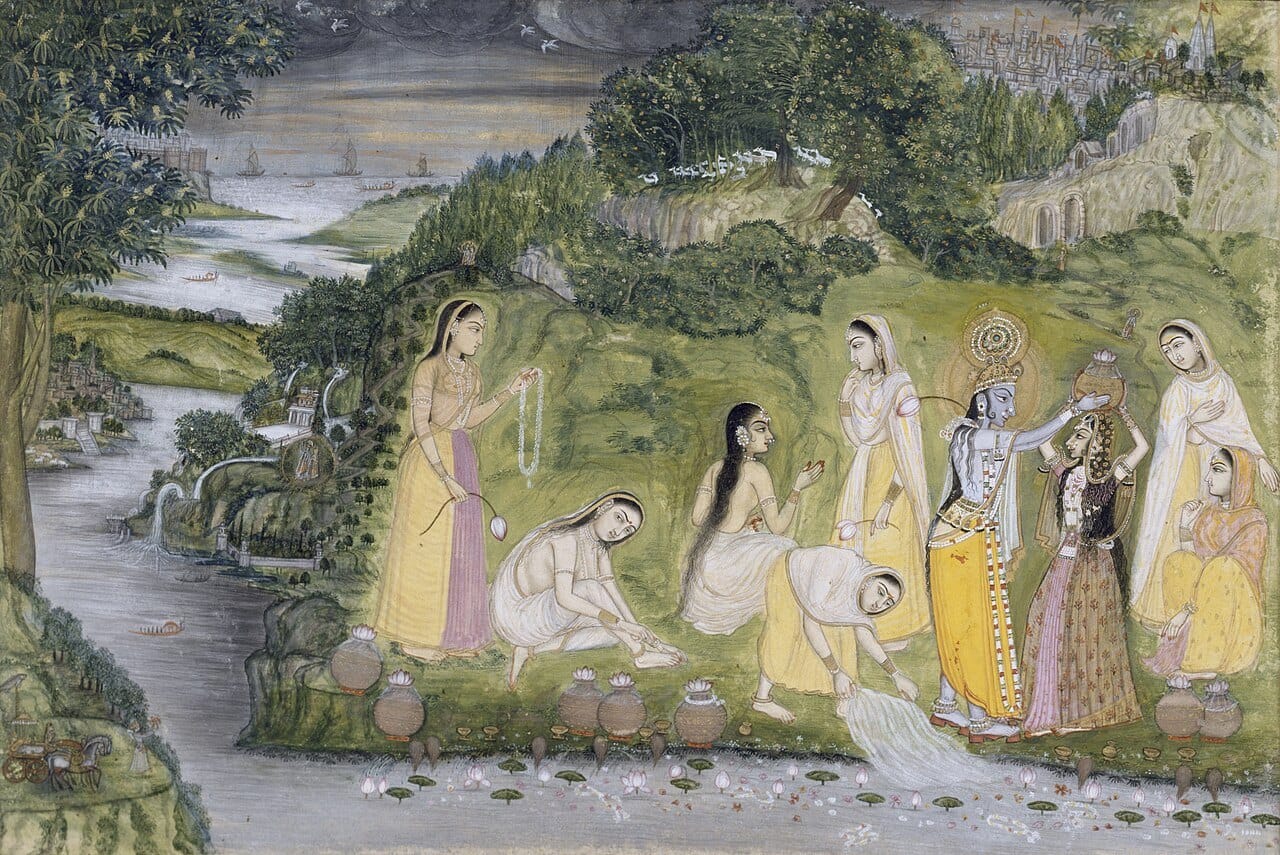
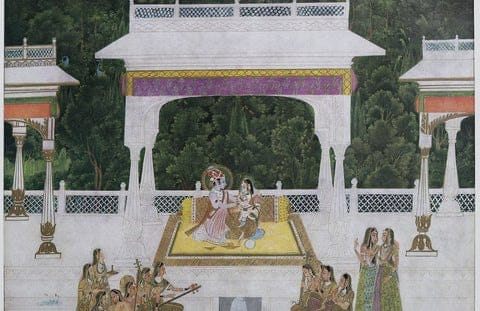
Look at a Kishangarh painting for the composition rather than the face and a consistent method appears. The viewpoint sits high. The water opens in a broad wedge from the foreground to a horizon placed near the top of the sheet. Architecture — marble pavilions, ghats, terraced gardens, garden walls — is used as a ruler, stepping the eye back in measured intervals. Cypress and flowering trees mark the middle ground. Boats sit out on open water to prove the scale. Only then are Radha and Krishna placed, often occupying a small fraction of the field.
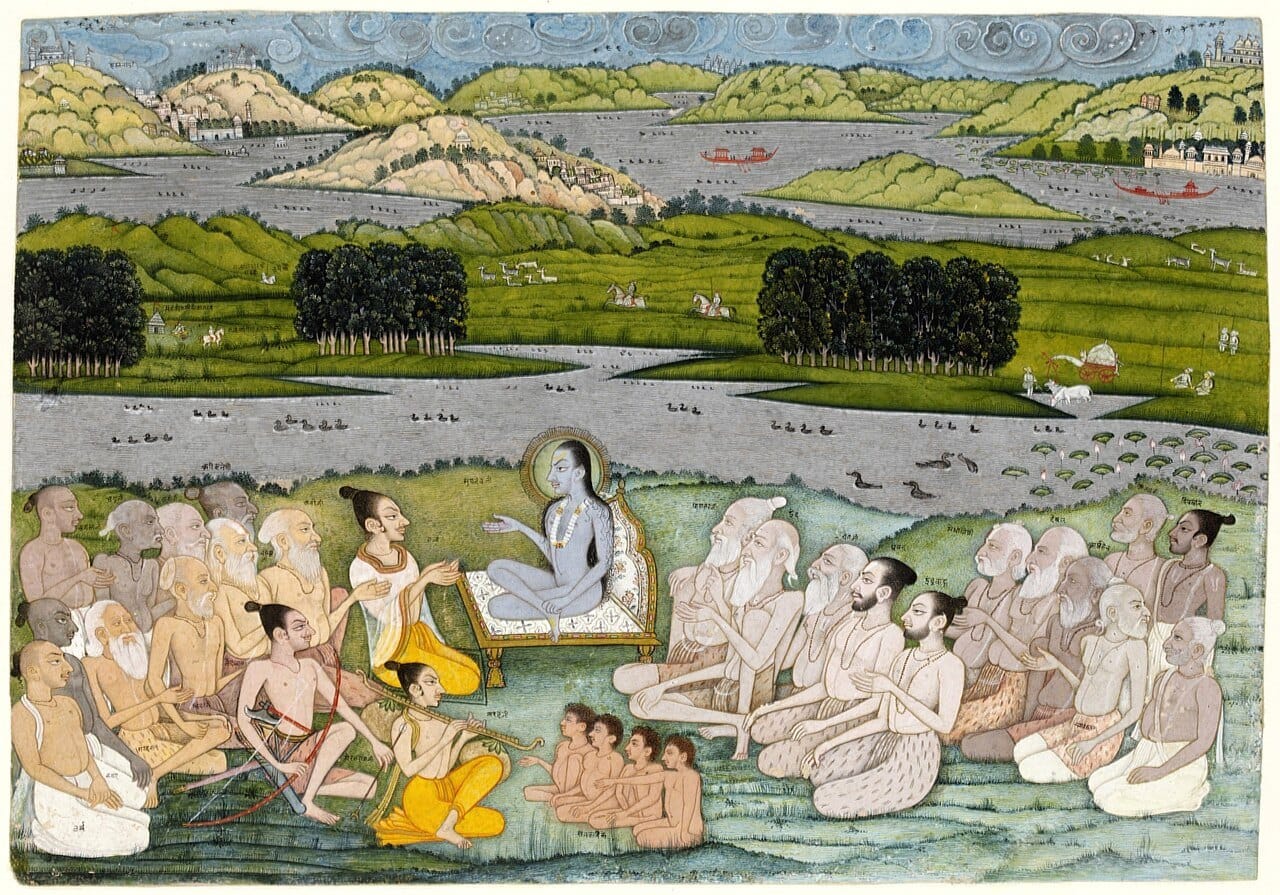
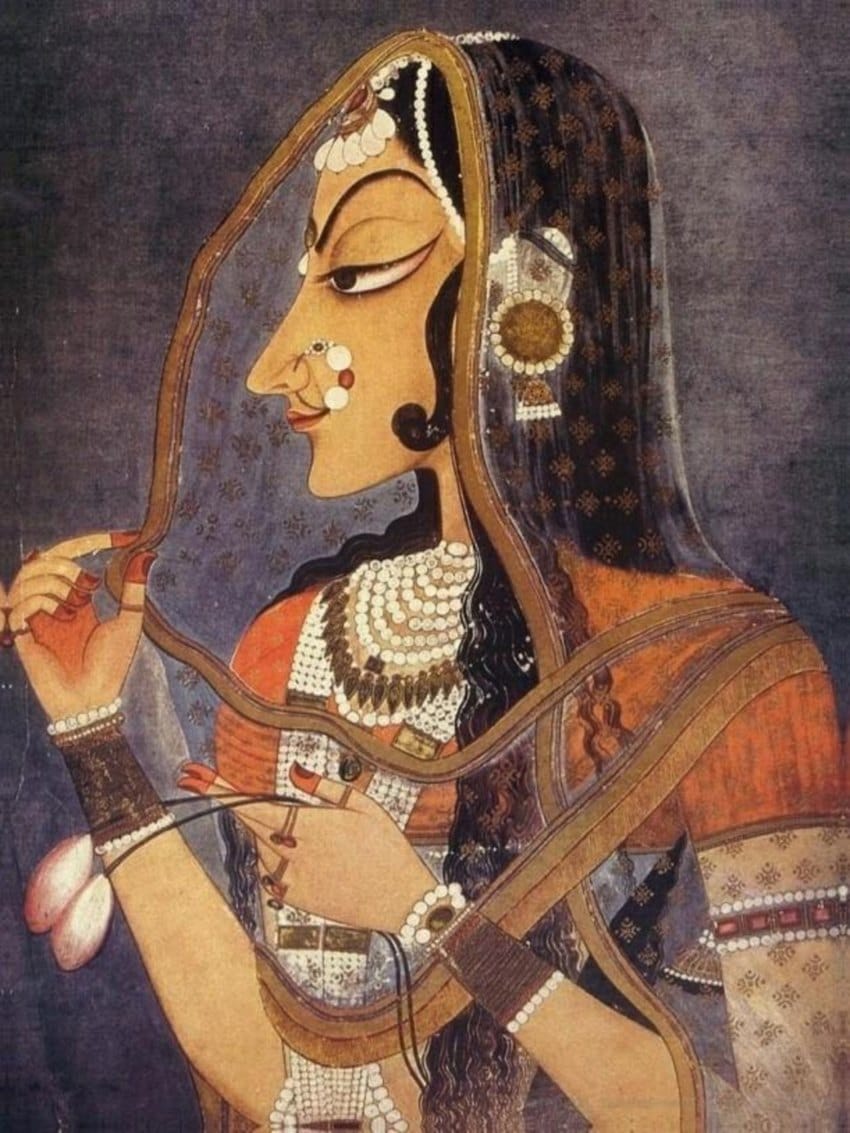
That choice does the emotional work. The poetry these paintings serve is as much about Radha’s separation as about union, and separation is a distance, so the school paints it as one. Nothing needs to happen in the faces, and nothing does: the brow sweeps up in one high arch, the eye runs long and half-lidded almost to the temple, the nose and chin come to points, a serpentine curl falls on the cheek, and the expression stays sealed. The famous physiognomy is not the statement. It is the fixed element against which the changing size of the world can be read.
The palette exists to make distance legible. Greens are silvered — malachite lightened with white — so the middle ground recedes instead of advancing; the lake is laid in lapis and indigo, marble in conch white, grounds in cream. Saturated colour is reserved for the two figures: rose, saffron and crimson for Radha’s drapery, Krishna’s body in blue-black, gold on jewellery and on the ripple of the water. The night paintings are the clearest demonstration of the whole system — the nauka vihar, or boat of love, where Radha and Krishna cross the lake in darkness, the lamps double in the water, and the two of them are the only warm thing for the width of the page.
Material Anatomy & Process
- The sheet. Wasli — layers of handmade paper pasted into a stiff board and burnished with agate. Kishangarh worked unusually large, some sheets reaching about 48 by 36 cm, and the reason is structural: a long recession needs room to run.
- The pigments. Lapis and indigo for water, malachite and terre verte for foliage, orpiment and peori for yellows, vermilion, conch white, lampblack for line, with gold and silver leaf burnished in.
- The brush and the repeat. Squirrel hair set in a quill, at its finest one or two hairs. Successful compositions were pricked and pounced so they could be used again — which is why the best Kishangarh landscapes survive in more than one version, with the setting held and the lovers altered.
The Literary & Spiritual Roots — the poetry behind the painting
- A patron who wrote. Savant Singh (1699–1764) took the throne in 1748 and gave it up in 1757 for Vrindavan. He was a serious poet in Braj bhasha under the name Nagari Das — servant of Nagari, that is, of Radha — leaving the Bihar-Chandrika, the Braj-Sar and the Pad-Muktavali, and writing in rekhta as well. His beloved, the singer Bani Thani, wrote as Rasik Bihari.
- Verses made into pictures. The link is documented: the Boat of Love illustrates the Bihar-Chandrika, the Pavilion in the Grove the Braj-Sar. The painter was answering a living author, and he answered the mood rather than the incident — which is exactly why the paintings are mostly setting. Savant Singh and Bani Thani are shown again and again as Krishna and Radha, not as flattery but as identification: in this devotional logic the devotee enters the lila rather than admiring it from outside, and the abdication of 1757 is the evidence he meant it.
- Viraha, painted as geography. Behind the court’s own verse stand Jayadeva’s Gita Govinda, the Bhagavata and the compressed couplets of Bihari’s Satsai, all built on Radha’s longing and delay. Other traditions carry that in gesture. Kishangarh converts it into square inches of water.
Heritage, Lineage & Field Notes
- What the school actually contributed. Indian painting of this period is overwhelmingly close-range. Kishangarh is the rare court idiom that thinks in long views, and its landscapes — lake, ghat, garden, horizon — are its real bequest, with the Gita Govinda, ragamala and barahmasa sets all bent to the same spatial habit and all returning to the same pair of figures.
- The icon, and the trap. The Bani Thani of about 1750, attributed to Nihal Chand, sits in the National Museum, New Delhi; Eric Dickinson called the figure the Indian Mona Lisa, and a commemorative stamp followed in 1973. Its fame flattened the school’s reputation into a face, and most later Kishangarh work repeats that face on a shallow ground — the formula without the idea.
- Where to look, and how. Cleveland holds a portrait of Savant Singh with Bani Thani; the Metropolitan Museum a Radha of about 1750; the Museum of Fine Arts, Boston, a Holi scene of 1750–60; the royal collection retains material at Phool Mahal. Judge any of them by the horizon first: if the space behind Radha and Krishna is thin, the painting is a later copy of a manner, not a work of this school.
The face is what people remember. The distance between Radha and Krishna is what the painters were actually making.