Radharani
Kerala Murals: The Fiery Geometry of the Southern Temple
The Origin & Regional Context
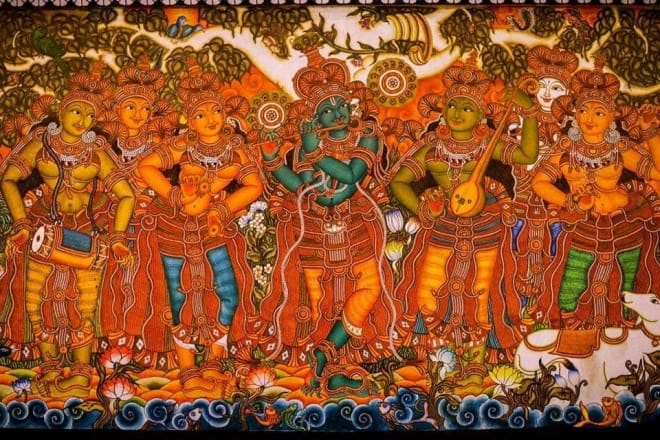
Some two and a half thousand kilometres south of the dusty river pastures of the Yamuna, on the humid, palm-fringed coast of Malabar, Braj assumed an entirely different architectural scale. Here, the romance of Radha and Krishna was not sealed inside private albums on sheets of wasli paper. It was painted directly onto the monumental lime-plastered outer walls of temple sanctums (Sri-Kovil) and royal palaces.
Flourishing between the 15th and 18th centuries under the patronage of the Zamorins of Calicut and the Maharajas of Travancore, Kerala mural painting was deeply intertwined with temple ritual and classical theater. While north Indian miniature schools drew upon intimate lyrical poetry, the Kerala muralists drew upon the muscular energy of Kathakali and Koodiyattam. In Kerala, Krishna is not a fragile, pale boy; he is a broad-shouldered, sovereign divinity whose presence vibrates through intense, warm earth pigments on massive temple walls.
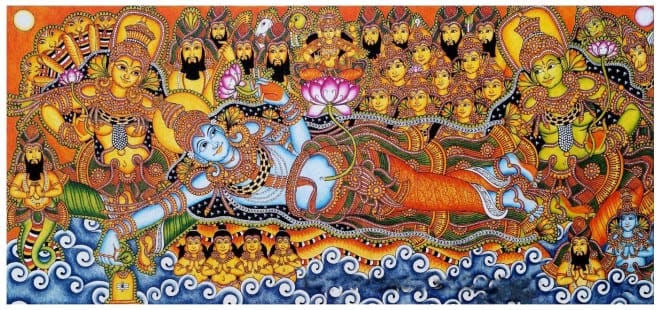
Visual Grammar & Iconography
Kerala murals are governed by the rigorous iconographic canons of the Chitrasutra and the Tantra Samuccaya:
- The Pancha-Varna (The Five Sacred Colors). The entire tradition is strictly limited to five organic and mineral tones: Yellow, Red, Green, Blue, and Black. White is never painted; it is the exposed, gleaming limestone ground of the wall itself.
- The Guna Philosophy of Color. Colors reflect cosmic states of being (Gunas):
- Satvika (Divine & Calm). Shades of radiant green, reserved for Krishna, Rama, and benevolent gods.
- Rajasa (Heroic & Passionate). Warm ochres, yellows, and cinnabar reds.
- Tamasa (Fierce & Destructive). Dark blues, grays, and blacks.
- Muscular, Heroic Proportions. Rejecting the delicate, slanting silhouettes of the northern courts, Kerala murals celebrate heroic fullness. Figures feature wide chests, heavy rounded limbs, narrow waists, and arched, open lotus eyes (padma-netra) that mirror the stylized expressions of Kathakali actors.
- Decorative Horror Vacui. Not an inch of the wall is left empty. Every gap between arms, legs, and halos is packed with swirling celestial vegetation, ornamental jewelry (abharana), flowering Kadamba clusters, and rippling waves.
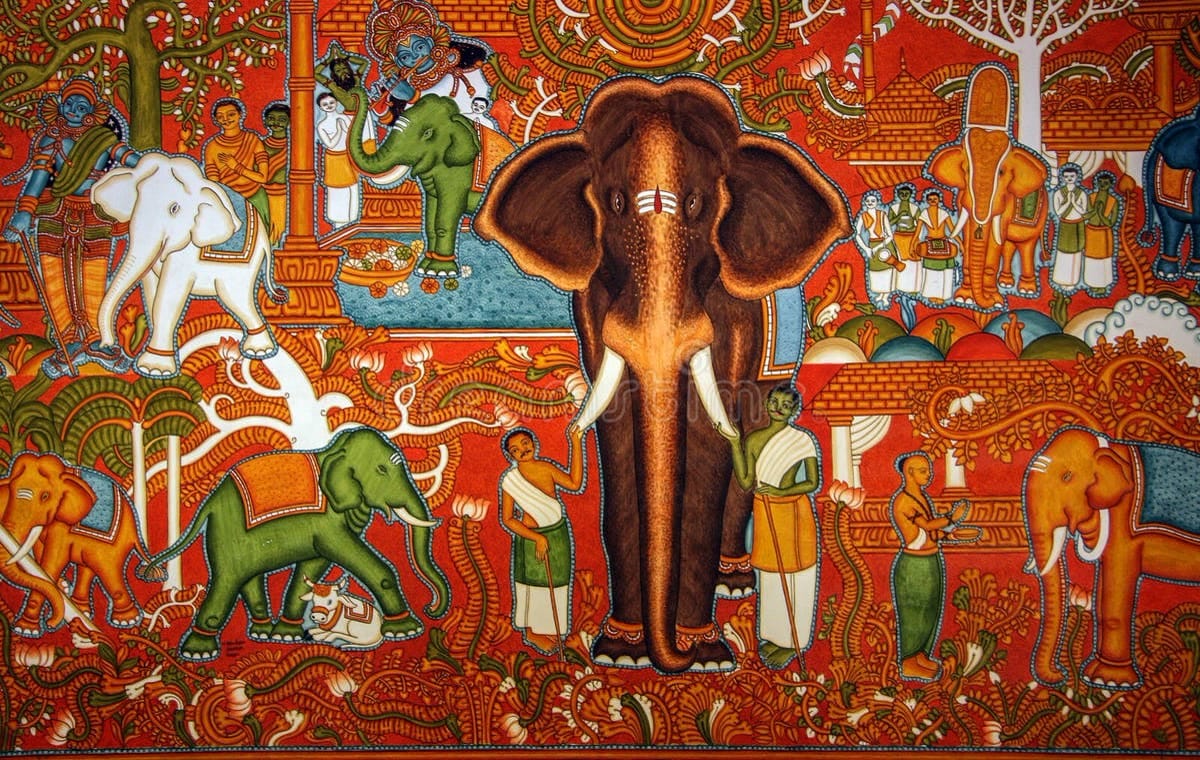
Material Anatomy & Process
The execution of a Kerala mural is an unhurried, multi-month mineral and organic ritual:
- The Wall Ground (Chitra-Bhoomi). The granite or laterite stone wall is plastered with a mixture of fine river sand and quicklime, soaked in coconut water and the bark decoctions of medicinal trees. The plaster is polished until it cures into a cool, rock-hard, moisture-resistant surface that breathes with coastal humidity.
- The Natural Pigment Kitchen
- Yellow & Red. Sourced from local laterite stones and cinnabar (hingula).
- Green. Derived by grinding the leaves of the Neelamari (wild indigo) combined with mineral eravikkara (gum resin).
- Blue. Extracted from pure indigo plants.
- Black. Carbon collected from oil lamps fueled by sesame or castor oil.
- Binding Medium. Pigments are ground with tender coconut water and neem tree gum (azadirachta indica), preventing microbial mold and ensuring the colors bind permanently with the lime plaster.
The Literary & Spiritual Roots
Kerala mural art is born directly out of the Sanskrit Dhyana Slokas (sacred meditative verses):
- The Narayaneeyam of Melpathur Narayana Bhattathiri. Composed in the late 16th century at the Guruvayur Temple, this 1,036-verse Sanskrit hymn compresses the entire Bhagavata Purana. It is the spiritual heartbeat of Kerala's Krishna devotion. The verses describe Krishna's beauty systematically, from crown to toe (Kesadipada), and muralists translate each syllable into strict geometric form.
- The Dhyana Slokas. Before putting brush to wall, the artist must chant the specific Dhyana Sloka that details the exact proportions, weapons, jewelry, complexion, and posture of the deity.
- The Transformation of Braj. In Kerala, the pastoral play of Braj (Gopala Lila) is viewed as an act of cosmic protection. When Krishna steals butter or subdues the serpent Kaliya, it is not rural mischief; it is the supreme protector (Jagannatha) restoring balance to the universe.
Heritage, Lineage & Field Notes
- The Traditional Master Guilds. Preserved by hereditary artisan families known as Perumthachans and court painters, the knowledge was passed down orally through Sanskrit verse manuals.
- Living Revival at Guruvayur. Following a devastating temple fire at the Guruvayur Temple in 1970 that destroyed historic sanctum murals, the Guruvayur Devaswom founded the Institute of Mural Painting at Guruvayur in 1989. Here, master artists continue to train students in the strict five-color discipline and traditional wall preparation.
- Where to Observe the Masterworks
- Mattancherry Palace (Dutch Palace), Kochi. Houses 16th-century royal bedroom murals depicting Krishna's Rasa-Lila and the Kaliya Daman.
- Padmanabhapuram Palace, Thuckalay. Pristine 17th-century wooden palace murals.
- Vadakkunnathan Temple, Thrissur. Monumental Shiva and Krishna wall frescoes.
The Kerala mural does not whisper its love. It chisels the divine out of stone, plaster, and earth, casting Krishna’s song across the temple walls for centuries to hear.