Radharani
Sanjhi Paper-Cut Art: The Ephemeral Geometry of Devotion
The Origin & Regional Context
Of all the visual traditions in this series, Sanjhi does not merely depict Braj; it was born directly within its soil. Rooted in Mathura and Vrindavan, the word itself traces to the Sanskrit sandhya (evening) or the Braj dialect sanjh (twilight). Folk memory holds that Radha first created Sanjhi by gathering wild forest flowers, fallen leaves, and colored stones in the twilight hours to sketch tender silhouettes of Krishna along the forest path to delight him upon his return from grazing.
During the 16th and 17th centuries, with the resurgence of the Bhakti movement under the Gaudiya Goswamis and the Pushtimarg sampradaya, this pastoral domestic ritual was formalized into high temple liturgy. During the sixteen days of Pitru Paksha (the autumn fortnight preceding Navratri), the inner sanctums of Braj temples, most notably the Radharamana and Bhattji temples of Vrindavan, transform into ritual workshops. Here, Sanjhi ceased to be a permanent keepsake. It became a daily, meditative performance: cut by day, dusted at dusk, worshipped by candlelight, and cleared away into the Yamuna before sunrise.
Visual Grammar & Iconography
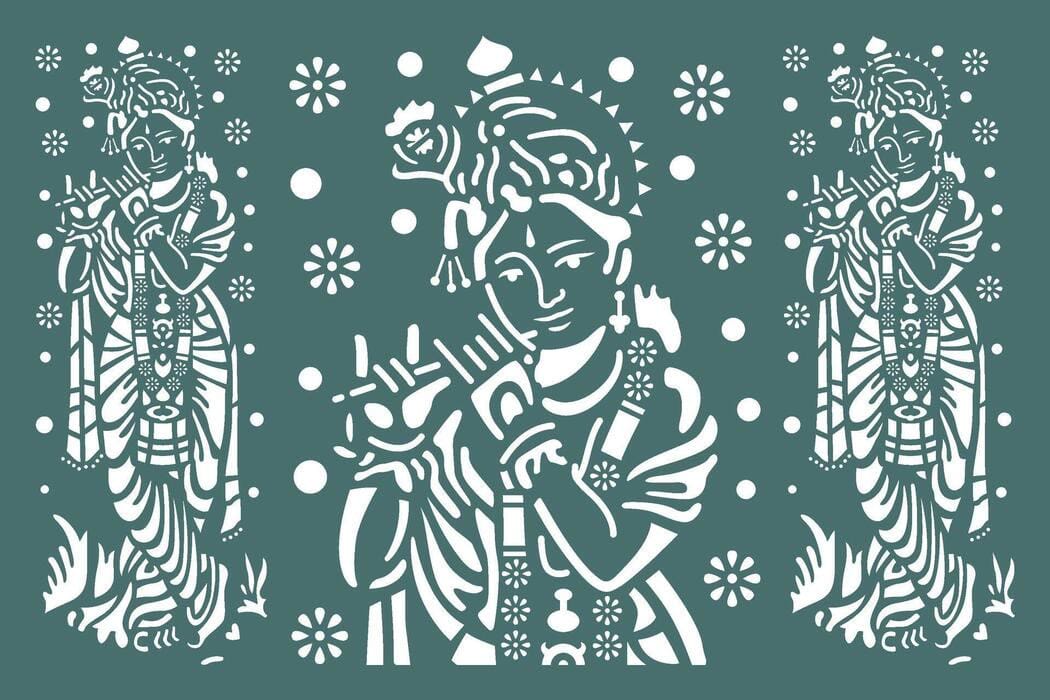
Sanjhi operates on an inverted visual principle: the artist does not apply lines to paper; they cut away emptiness so light and pigment can pass through.
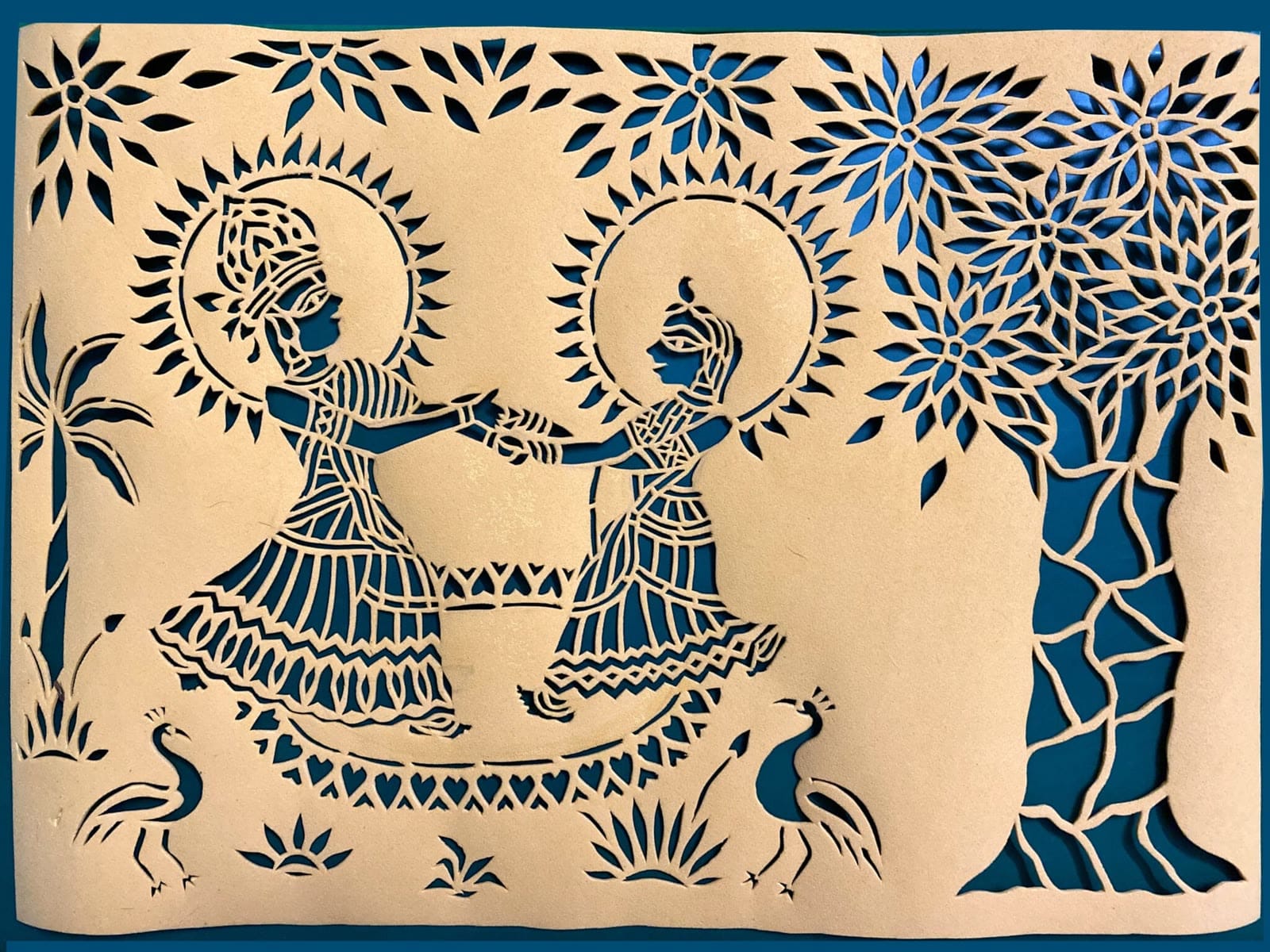
- Negative Space as Outlines. There are no drawn boundaries. The brush is replaced by empty air. The artist must visualize the entire scene in reverse, ensuring that as inner sections are snipped out, the structural bridges (bandhas) remain intact so the stencil does not collapse.
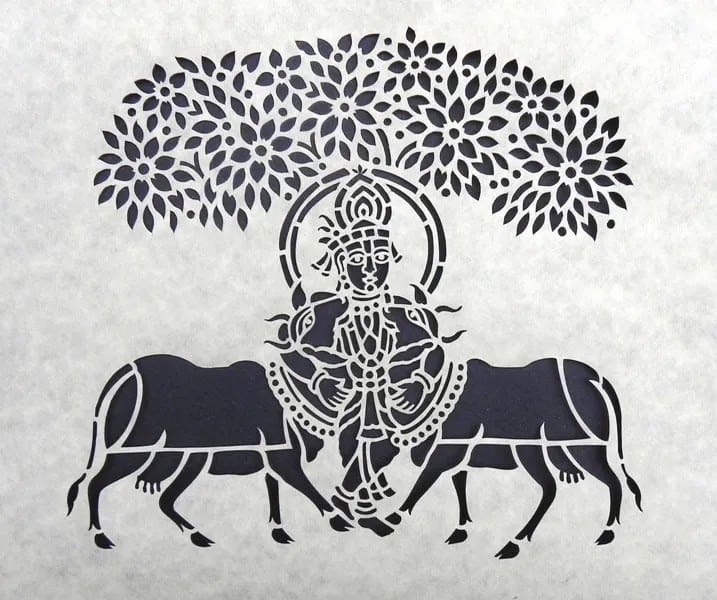
- The Octagonal and Circular Mandalas. Compositions are predominantly circular or octagonal (ashtakona), echoing the lotus ponds of Vrindavan or the cosmic circle of the Raas. The outer borders ripple with cascading foliage, parrots, and peacocks, while the sanctum center holds the Yugal Sarkar (Radha and Krishna standing under the Kadamba).
- The Miracle of Jal Sanjhi (Water Stenciling). While Bhoomi Sanjhi is laid flat on dry plastered mud floors, the pinnacle of the art is Jal Sanjhi. Dry mineral powders and ground marble dust are gently sifted through the paper stencil onto the still surface of water inside an octagonal brass shallow vessel. Remarkably, through water tension and oil binders, the colored powders float unmixed, creating an immovable painting upon liquid. In rare variations, the design is dusted on the bottom of the dry vessel, coated with an oil film, and water is poured over it without dissolving the motif.
Material Anatomy & Process
The physical execution of Sanjhi requires absolute physical stillness, steady breath, and specialized handcraft tools:
- The Stencil Paper. Historically executed on handmade rag paper, coated with mustard oil to make it water-resistant and crisp, allowing the cut edges to remain razor-sharp over multiple siftings. Multiple sheets are folded together to cut mirrored bilateral symmetries with a single snip.
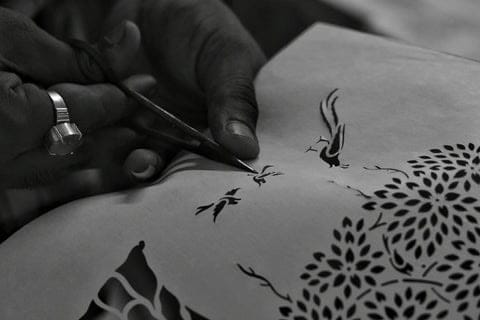
- The Tool (Paunshi). The master uses neither a knife nor a scalpel. They wield paunshi, small, scissor-like pincers with curved, upward-bent fine tips. The paper is manipulated with the left hand while the scissors remain almost stationary, clipping rapid, microscopic curved notches into the fibers.
- The Dry Pigments (Bhilawa & Minerals). The colors dusted through the stencil are completely dry:
- White. Finely ground Makrana marble dust or calcined conch-shell powder.
- Yellow & Ochre. Raw haritala (orpiment) and yellow clay (peori).
- Red & Vermilion. Pulverized cinnabar (hingul) and red oxide (geru).
- Blue & Green. Indigo and powdered malachite stone.
The Literary & Spiritual Roots
Sanjhi is the visual counterpart to the Braj Bhasha poetry of the Ashtachhap poets such as Surdas and Kumbhandas, and of Braj saints like Hariram Vyas.
- The Poetry of Twilight (Sandhya Ke Pad). As the priests dust the pigments through the stencils in the temple courtyards, singers accompany the process with verses describing Krishna bringing the cows home at sunset (Godhuli Bela), his hair covered in golden meadow dust.
- Ritual Impermanence (Kshanabhangurata). Unlike court miniatures painted on wasli paper meant for royal archives, Sanjhi embodies the Bhakti philosophy of detachment. The most elaborate Sanjhi, requiring twelve hours of continuous cutting and dusting, is viewed only for the duration of the evening Aarti. At dawn, the entire dry painting is gently swept up, gathered into brass urns, and immersed into the flowing current of the Yamuna. The art is not a commodity; it is an act of breathing out.
Heritage, Lineage & Field Notes
- The Hereditary Priestly Lineages. Sanjhi is historically preserved not by secular painter guilds, but by the hereditary Vaishnava temple priests and goswamis of Mathura, Vrindavan, and Radhakund. Master families such as the Verma family of Mathura have guarded the secret template archives (khakas) across three centuries.
- Living Status & Revival. Because temple ritual time has contracted, genuine temple-floor Sanjhi is practiced by fewer than a dozen master families today. However, contemporary masters have adapted the paper stencils themselves into backlit shadow-lamps, architectural screens (jalis), and fine standalone art pieces.
- Where to Observe Sanjhi
- Radharamana Temple, Vrindavan. Active temple Sanjhi displays during the autumn Pitru Paksha fortnight.
- Bhattji Mandir, Mathura. Famous for the floating Jal Sanjhi ritual.
- National Handicrafts and Handlooms Museum, New Delhi. Houses master archival paper stencils cut by legendary master Mohan Lal Verma.
Sanjhi was never meant to be preserved under museum glass. It was made to teach the heart that divine beauty is most radiant when you are ready to let it go.