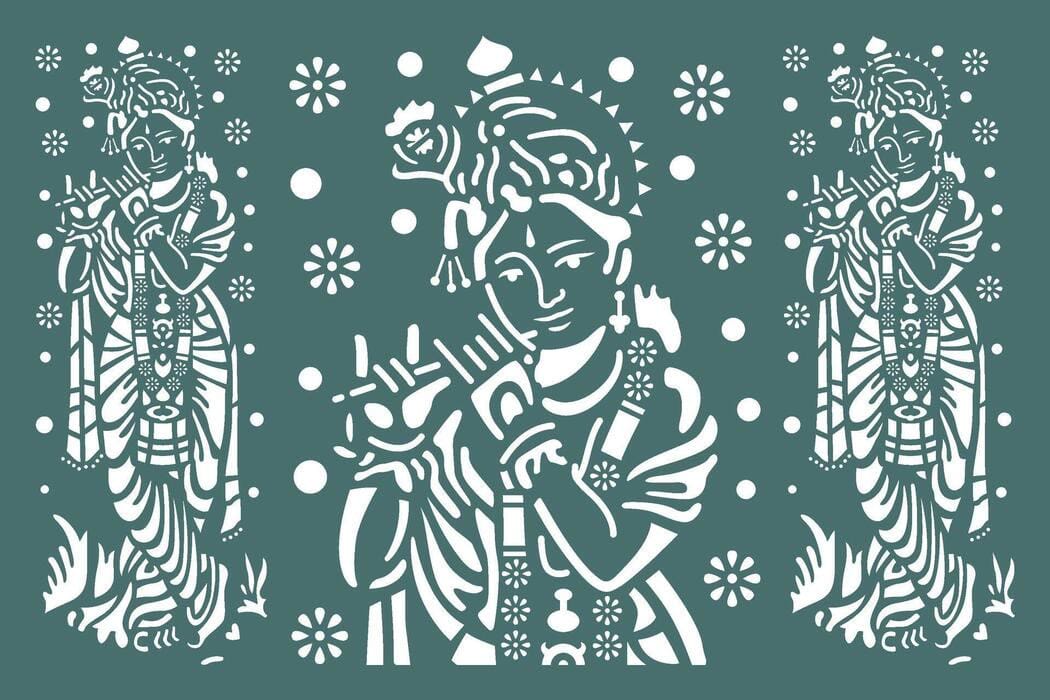
Radharani
Pichwai Painting of Nathdwara: How a Cloth Behind the Lord Became a Calendar of Devotion
A pichwai is not a painting of a season. It is the season itself, hung where the Lord can be seen against it.
The Origin & Regional Context
Pichwai takes its name from the place it occupies rather than from anything it depicts. The word joins pichh, behind, and wai, hanging: the cloth that hangs behind the deity. The tradition belongs to Nathdwara, a temple town in the Rajsamand district of Rajasthan, roughly forty-five kilometres north of Udaipur, on the banks of the Banas. But the art does not begin there. It begins in Braj, and it arrives in Rajasthan the way a household arrives — carrying its furniture.
In the last decade of the fifteenth century Vallabhacharya (1479–1531) came to Govardhan Hill and recognised, in an image emerging from the rock, the swaroop that would come to be called Shrinathji: the left arm raised as though holding the hill aloft, the right hand closed at the waist. Around that image he built Pushtimarg, the Path of Grace — a discipline founded not on ritual observance but on seva, loving service. In Pushtimarg the Lord is not an idol to be propitiated. He is a child of about seven to be woken, bathed, dressed, fed, played with, sung to and put to rest. The distinction is not sentimental. It is structural, and it is the reason this school of painting exists at all.
It was Vallabhacharya's second son, Vitthalnath — known to the sect as Gusainji (1516–1586) — who gave that service its full architecture. He divided the day into eight periods of darshan, fixed the shringar, the adornment appropriate to each hour and each season, and set the festival calendar the sect still keeps. Because the Lord was served as a living child in a haveli rather than worshipped as a fixed image in a shrine, everything around him had to change as his day changed: his clothes, his jewels, his food, the music sung to him — and the cloth at his back.
The day the cloth has to keep
The Nathdwara haveli does not stay open through the day. It opens eight times, for short spells, because a child who is made to stand too long would tire. The eight jhankis — glimpses — run in a fixed order: Mangala, the waking at dawn; Shringar, the bathing and dressing; Gwal, when he sets out with the cows; Rajbhog, the midday meal, after which the doors close for his rest; Utthapan, the waking from that rest; Bhog, the evening refreshment; Sandhya Aarti, the lamp waved by a mother for a son come home; and Shayan, when the flute is given back to him and he is put to bed.
Each of those eight has its own bhava, its own offering, its own kirtan and its own shringar. His clothes are stitched fresh by the darjikhana and are not repeated. In summer the darshans open later, because he plays longer and sleeps in; in winter he is wrapped and a coal fire is lit before him. A painter working in this town is therefore not making a picture for a wall. He is making one item of a wardrobe that has to fit an hour, a season and a mood, and be taken down when that hour passes.
The journey out of Braj
The seventeenth century forced the tradition to move. In 1669, under Aurangzeb, the shrine at Govardhan came under threat and the image was taken out of Braj. It travelled for nearly seven years, and it did not travel alone: priests, cooks, cowherds with their cattle, singers and painters went with it. The party moved through Agra and across the Rajput states — Kishangarh, Bundi, Kota among them — and ruler after ruler declined shelter for fear of the Mughal court. Rana Raj Singh of Mewar did not. On 10 February 1672 the image was installed at Sihad, a village on the Banas, and the town that grew around it took the name Nathdwara — the gateway (dwar) of the Lord (nath).
Painter families settled around the haveli and stayed; lineages recorded in the town's history include the Adi Gaur, Jangid and Mewara communities. They were not court artists working to a patron's taste; they were householders working to a liturgy. That single fact shapes everything else about this school. Its subjects are not chosen. They are scheduled.
Visual Grammar & Iconography
The fixed centre
Shrinathji on cloth follows the swaroop in the sanctum and is not open to a painter's invention. He is shown frontally, never in profile: left arm raised, right hand at the waist, the body full and rounded, the nose broad, the eyes very large and elongated, the skin a deep luminous blue-black. The composition is then arranged in symmetry around him. Where other traditions ask a viewer to read a scene across the page, a pichwai asks for darshan — a meeting of eyes, at standing height, with the cloth doing the work of setting and season.
This is also why the school avoids perspective and avoids drama. A pichwai holds still. The viewer is not being told a story; the viewer is being received. Figures are ranged in rows, the ground is flat, the symmetry is close to absolute, and the eye is returned again and again to the centre rather than carried around the field.
A grammar of surrounds
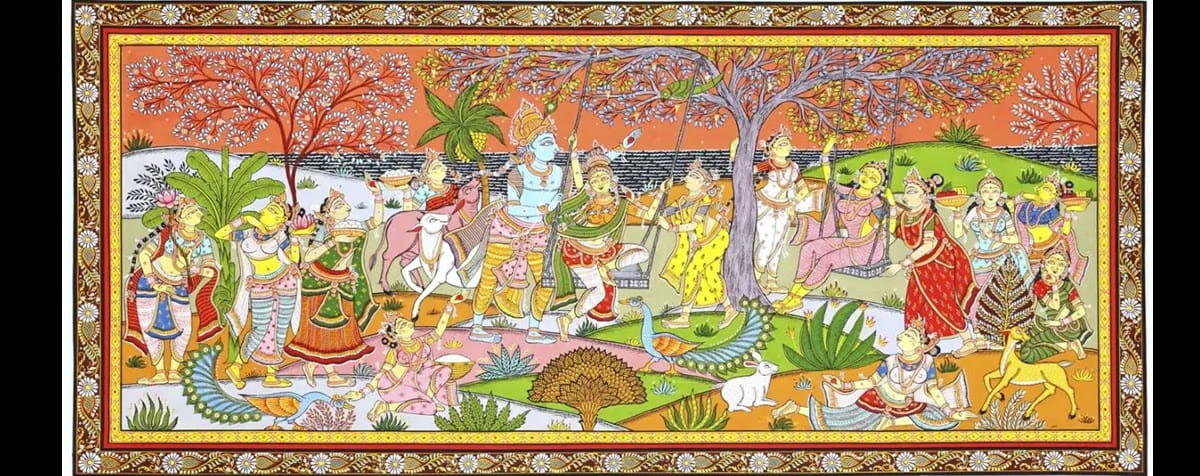
What the painter does control is the world assembled around that centre. Cows appear in almost every pichwai — sometimes as the herd of the gocharan lila, Krishna's day out grazing, and sometimes as a single Kamdhenu, the wish-fulfilling cow, standing for abundance and for the earth itself. Lotus ponds, kamal talai, fill the lower register. Kadamba and plantain frame the field. Peacocks gather in the morkuti compositions of the rains. Rows of gopis approach from either side carrying offerings, their number and posture regulated by the occasion.
Many large pichwais carry a border of small framed panels — twenty-four is a common count — each holding a separate lila, so that the whole cloth reads as a year folded around a single day. On festival cloths the celestials are often added at the top of the field, ranged in the sky and looking down: the convention says that even the gods come to watch this particular play.
The six seasons
The Pushtimarg year runs on six seasons rather than four, and the cloth is expected to answer all six. In the heat the field fills with pink lotuses and open water, because the image is being cooled. The rains bring dense green, dark cloud and dancing peacocks. Autumn brings the moon. Winter thickens the shringar and warms the palette. The painter is not choosing a mood; he is dressing a room for a particular week of a particular season, and a cloth hung out of season is simply wrong in the way a winter quilt in June is wrong.
The festival set
The repertoire is finite and well known inside the tradition. Annakut, the mountain of food offered the day after Diwali, with Shrinathji standing before ranks of vessels. Janmashtami and the Nand Mahotsav that follows it, with the cradle and the rejoicing of the village. Gopashtami, the day Krishna takes up the herd, with the cows at the centre of the field. Sharad Purnima and the Raas. Dan Lila, the toll demanded on the path. Dolotsav, the Nathdwara Holi, with its swings and colour. Chhappan Bhog, the fifty-six offerings. Each has its own palette, its own hour and its own arrangement of figures, and each is hung only on its own day.
The chromatic register
Across the school the grounds are deep — red and maroon above all, then indigo, malachite green, ochre and saffron, with black reserved for night scenes. White comes from zinc and from ground conch. Outlines are drawn in fine lampblack. Real gold and silver leaf carry the ornament, the hem of the pitambar, the crown and the border. A dark band closes the outer edge of almost every cloth, the way a threshold closes a room.
Against all of this the Lord's own blue reads as the darkest and most luminous thing in the field, which is exactly the intention. Colour here is doing two jobs at once: it fixes the season, and it makes a single figure unmissable in a sanctum lit by lamps.
What a pichwai does not do
It does not attempt likeness, and it does not attempt depth. It carries no portrait of the donor, no landscape observed from life, and — in the classical tradition — no signature. The painter's name is not on the cloth because the cloth is not his statement. It is an offering made on someone else's behalf, in a room where the offering, not the offerer, is meant to be looked at.
Material Anatomy & Process
- The cloth. Handspun cotton, washed repeatedly to strip the oils, then sized with a starch of rice or wheat flour so that pigment sits on the surface without bleeding. For a full temple pichwai — commonly ten to twelve feet — widths are joined before sizing. Some workshops build the ground with a paste of tamarind seed, chalk and gum, then burnish it with a smooth agate until it is even enough to take a hair-thin line.
- The drawing. The composition is set out first in charcoal burnt from tamarind twigs, working from the central figure outward, because the centre is fixed and everything else has to be placed around it in balance.
- The pigments. Stone and earth colours ground by hand and bound in gum: indigo, vermilion, malachite, red and yellow ochre, terre verte, zinc white, conch white and lampblack, with saffron for particular warm passages. The painting is done in tempera, laid in flat layers — ground first, then the figures, then ornament.
- The gold. Gold and silver leaf go on last, over the finished colour, which is why ornament on an old pichwai sits slightly proud of the surface and catches light as the viewer moves in front of it. On a cloth made to be seen by lamplight in a sanctum, that is function rather than decoration.
- The tools. Brushes of squirrel and goat hair, some fine enough for a single eyelid; colour kept in coconut shells; the agate burnisher for the ground; broad brushes of goat tail for the large flat fields.
- The time. A large temple pichwai is months of work, often by more than one hand within a family, and it begins with the words spoken over the cloth before the first line is drawn: Jai Shri Krishna.
- Two streams. Temple pichwais, made for the haveli itself and changed through the year; and the smaller haveli and pilgrim pichwais that carried the same iconography into priests' houses and devotees' homes — the reason the school spread far beyond Rajasthan, into Gujarat, Malwa and the trading towns of the Deccan.
The Literary & Spiritual Roots — the poetry behind the painting
- The Ashtachhap. In 1565 Vitthalnath gathered eight poet-singers into the service of Shrinathji: Surdas, Kumbhandas, Paramananddas and Krishnadas, who were disciples of his father, and Nandadas, Govindswami, Chhitswami and Chaturbhujdas, who were his own. Chhap means seal — the signature line each poet closed his pada with. Their compositions in Braj bhasha are not devotional literature written alongside the worship. They are the worship.
- Song sets the subject. Each poet was given charge of a portion of the day's seva, and the kirtan sung at a given hour describes a particular lila — the waking, the grazing, the return of the herd at dusk. The cloth hung behind the Lord at that hour shows the same lila. This is the key to reading the school: a pichwai is not an illustration of scripture, it is the visible half of something being sung in the room.
- Haveli sangeet. The music is rooted in dhrupad and is still performed at Nathdwara, in Braj bhasha rather than Sanskrit — a deliberate choice, since Vallabhacharya held that love-devotion needs no learned mediation. Its slow, unhurried measure is the closest thing there is to a description of how a pichwai is meant to be looked at.
- Surdas and the child. Surdas, the most widely known of the eight, filled the Sursagar with the Lord's childhood — the stolen butter, the mother's complaint, the mud in the mouth. Because the deity at the centre of this tradition is seven years old, the dominant feeling in pichwai is not romantic longing but vatsalya, the tenderness of a parent, and sakhya, the ease of a friend. Madhurya enters through the gopis, but it is never the whole weather of the cloth.
- Why that matters to a painter. Vatsalya sets the register of the whole school. It explains the roundness of the figure, the absence of tension in the composition, the abundance of food and cattle and flowering trees, and the refusal of anything that would read as spectacle. The cloth is meant to feel like a well-run household on a good day.
- The sect's own narrative. The Chaurasi Vaishnavan ki Varta, the accounts of eighty-four Vaishnavas compiled in the tradition of Gokulnath, gave painters incidents, characters and the tone of the household — a body of story sitting behind many compositions a viewer might otherwise read as generic.
Heritage, Lineage & Field Notes
- A living wardrobe, not an archive. Nathdwara's chiteras have worked in hereditary lines since the town was founded, and the craft never became purely retrospective. Cloths are still made for the haveli's own use and still rotated through the year. The oldest surviving pichwais are roughly two to two and a half centuries old — not because the tradition is younger than that, but because a cloth in daily service wears out and is replaced.
- The nineteenth century. As pilgrimage to Nathdwara grew, the town's painters began producing smaller cloths and paper works for visitors to carry home, and the iconography spread across western India with the merchant families of the sect. Sizes fell from the ten-to-twelve-foot temple format to something that could be folded into a trunk.
- Geographical Indication. Nathdwara Pichhwai Painting is a registered Geographical Indication in the handicrafts class. Application no. 748 was filed on 12 April 2021 by the Mewad Art and Craft Sansthan of Nathdwara, published in GI Journal no. 172 on 30 March 2023, and granted registration certificate no. 488 on 31 July 2023, valid until 11 April 2030.
- Where the work is held. The richest living collection is the Nathdwara haveli's own seasonal store, which is not a museum but a working wardrobe. Beyond it, holdings include the National Museum, New Delhi, and the Metropolitan Museum of Art, New York, which received a nineteenth-century Nathdwara pichhwai as a gift of the Friends of Asian Art in 2003.
- A note for the buyer. Scale is the first tell. Temple pichwais were made at ten to twelve feet; most cloths offered today are two to four. Size alone proves nothing, but hand-ground mineral colour, gold that sits proud of the surface, a slight irregularity of line and a correctly observed swaroop — left arm raised, right hand at the waist — are what separate a painted pichwai from a printed one.
- And a note on reading one. Before asking what a pichwai depicts, ask when it was meant to hang. The season and the festival are not background information. They are the subject.
The cloth changes because the day changes. That is the whole art.